Sunday, June 16, 2013

The Name Game (Part I)

Early in life I learned the pleasure of naming animals, as well as the power that came with it.  I was a suburban Adam, labeling the critters in my tiny universe—turtles, rabbits, and (mostly) dogs.  When our dog Tippy gave birth to a litter of puppies, I named one of them Jerry—after myself—hoping, I supposed, that my parents would let me keep him.  They didn't.

That's me holding Jerry the dog.

Tippy was the first in a succession of family dogs.  Next came Sally and then Sox, who lived to the ripe old age of eleven.  Sox was certainly not an original name (how many dogs and cats have been burdened with that too-cute moniker?), but I must have thought the spelling was clever.  Sox was a Border Collie mix, but the only way she even remotely resembled a Border Collie was in her coloring.  She had the energy of an old cat and was just as interested in fetching, or playing at all, really.  However, she was the most loyal dog I've ever had, and she wanted nothing more than to be loved.

Sox in her golden years

My adult experiences with dogs have been less fortunate.  After a sweet but high-strung Dalmatian named Barney was killed (by a train, of all things), I adopted a mutt named Effie (after Sam Spade's secretary in The Maltese Falcon).  My ex-wife let me choose the name because she knew I was resistant to getting the dog.  I was right to be.

The first night we had Effie (she was just a few months old), she whined endlessly, and when I reached into her kennel to comfort her, she bit through my thumb.  When I turned the light on, I could see that she was frothing at the mouth and convulsing.  In the morning I made a trip to the doctor's office for a tetanus shot while Cindy rushed Effie to the vet's.  The poor pup had suffered a seizure, brought on by distemper, and from that point on, she suffered the effects.  She was often unruly, aggressive, disoriented  A year later she was diagnosed with cancer, but after a series of complicated (and costly) procedures, she recovered.

Effie on a rainy day—the oppressive
weather matched her personality.

When Cindy and I divorced and I had to move to an apartment in another town, it was obvious that neither of us could keep Effie.  But I found her a good home with a loving family, and the last time I saw Effie, she was happier than ever.

After my two previous experiences, I decided to steer clear of dogs, and it would be another ten years before a four-legged critter walked into my life.  That, of course, was Chabo, whom I described in an earlier post.

The ever-circular Chabo doing what she did best

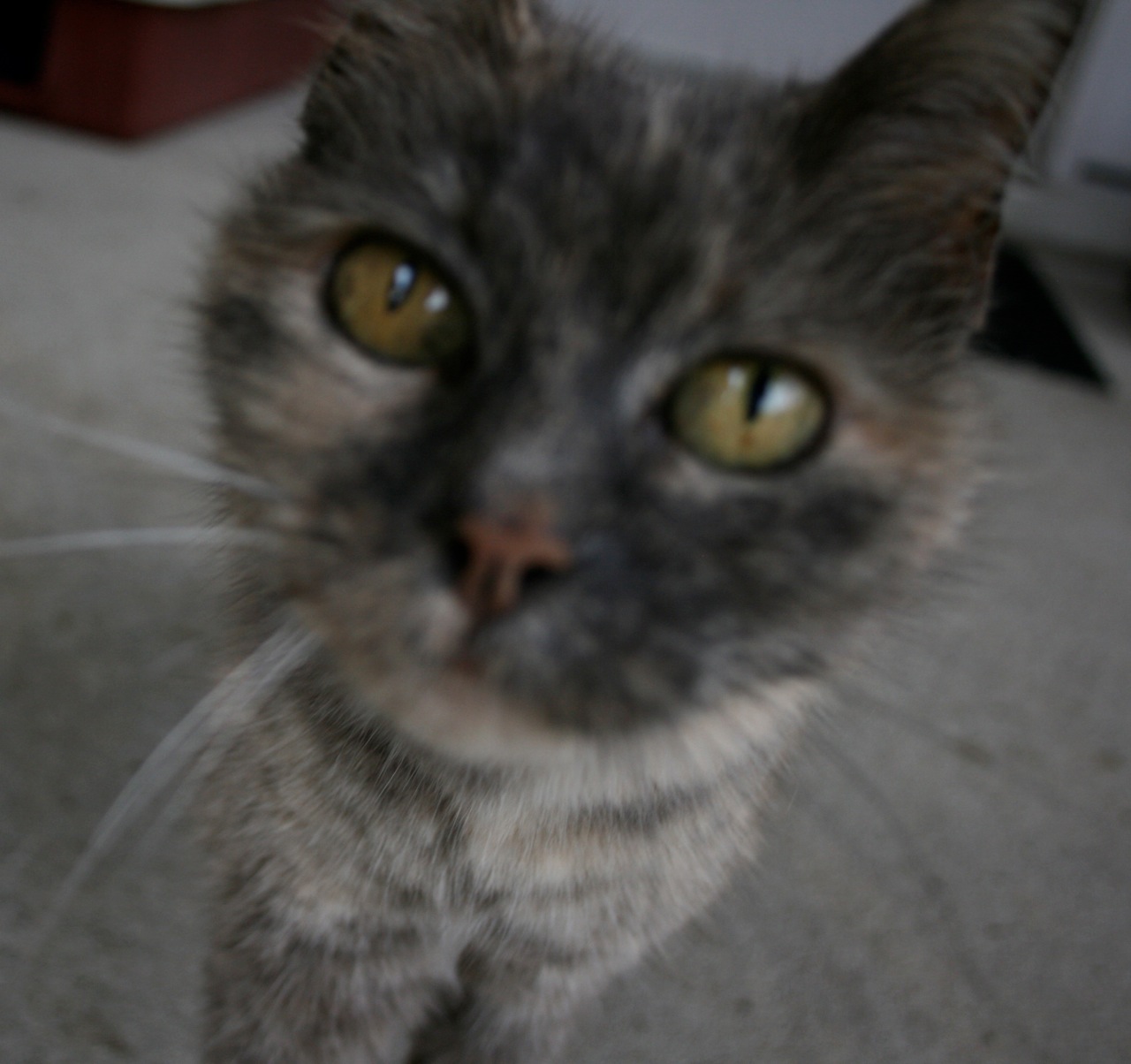
When Chabo died, my wife Susan wanted to get another cat almost immediately, but for a variety of reasons, none of which I will chronicle here, we didn't find a suitable match for two months.  Less than a week ago, however, Susan and I adopted a six-year-old tabby named Samantha, a "Second Chance Pet" who needed us as much as we needed her.  Beyond the immediate circumstances that led to her being in a foster home, we know very little about Samantha, but given the hard life she has led in recent months, we didn't have the heart to rename her.  She deserved to hang on to her own identity.

That being said, Susan and I have already given her several nicknames—Riley, Rita, and Zonkers, among others—but she will always be little Sam, who just might be the sweetest cat I have ever known.  But we have barely gotten to know each other.

Sweet little Samantha


Sunday, June 9, 2013

Bedtime for Brownie


Susan with Blue, along with baby blanket and quilt, 
all of which Susan still owns


Like most little girls, my wife Susan loved her stuffed animals. She never cared for Barbie dolls—or other plastic toys, for that matter—filling her bedroom, instead, with a menagerie of furry friends. One of her favorites was a floppy-eared dog named Blue. He was Susan's first stuffed animal, and he shared her crib from early infancy.


Over the years Blue's fur has worn in spots, and his coat has appropriately aged to white. Despite losing his nose and tongue, he has managed to hang in there. Susan still has him in her possession.


Blue, as he appears today—a little worn and not so blue

Blue was a snuggly pooch, and for several years he shared Susan's bed with a dozen or more stuffed toys. One night when Susan was eight years old, she crawled into bed with another prized companion, a teddy bear named Brownie. Like Blue, Brownie played music. As Susan settled down to sleep, she wound Brownie's little music box, expecting to hear the familiar strains of a lullaby, but her little companion produced barely a note.


Maybe she had over-wound the stem, or perhaps the bear had endured one too many cycles in the washing machine, but no pleading or shaking of the bear could coax him to play. Naturally, Susan turned to her parents for help. She padded into the living room, bear in tow, and handed him to her father, explaining the problem. "Cheap piece of junk," he grumbled, before tossing the hapless Brownie into the fireplace and atop the still-smoking embers. I can only imagine Susan's shriek of alarm or her father's look of surprise at that moment.

Susan's mother, fortunately, had the wherewithal to save Brownie. She pulled the singed bear from the embers, dusted him off, and shepherded little girl and animal safely to bed.

Susan was not traumatized by this experience, nor did she judge her father harshly for the way he handled the situation. "He was just a little impatient," she notes, coming to his defense, and she always recounts the narrative with a smile. "Dad had a short temper," she adds, reacting to my skeptical look.

Still, I have to think Brownie's near incineration had to affect the way Susan viewed her father. Surely, we all experience pivotal moments when we see our parents with fresh eyes. Some people may cruise through childhood believing their parents can do no wrong, but most of us experience "Brownie" moments.  I certainly did.

Susan's experience reminds me of Sharon Olds's poem "The Clasp," about a mother who loses patience with her four-year-old daughter after the girl repeatedly pushes her toddler brother onto his face. Finally, the mother (who narrates the poem) grabs the girl's wrist and "compresse[s] it, fiercely, for a couple / of seconds, to make an impression on her, / to hurt her" (5-7). The narrator describes how "[i]t happened very / fast—grab, crush, crush, / crush, release," (11-13), as such things do, and it is clear that the mother knows she went too far and did not intend to hurt her daughter, her "beloved firstborn" (7).

What echoes Susan's experience is the daughter's reaction to her mother's extra exertion of force. The narrator says that her daughter's "deeply open eyes took me / in, she knew me, in the shock of the moment / she learned me" (18-20). I sense that Susan "learned" her father—in all his complexity—when he tossed Brownie onto that fire. She learned that he did not like to be bothered, that he wasn't always focused on her needs, that he could be cruel.

Susan also learned that her father had a good heart and that he quickly realized his mistake. A few minutes after Susan's mother tucked her back into bed, Susan's father paid his daughter a visit. He went to her bedroom and apologized for what he had done.

Olds takes her poem in a darker direction when the narrator confesses to the readers that she "even almost / savored the stinging sensation of the squeezing, / the expression, into her, of my anger" (7-10). While not exactly comforting, those key words—"even almost"—assure the readers that the mother is not abusive, just human ... and honest.

I cannot end without reporting on Brownie's current condition. Like Blue, he is still in Susan's possession, as well loved as ever.  His eyes look a little scratched and his fur is a bit matted. If you are brave enough to wind his music box, he will repay you with a tune, but you have to be patient: "Rock-a-bye Baby" will trickle out for half an hour or more—one sweet, sad note at a time.


The scrappy Brownie, as adorable as ever


Works Cited
Olds, Sharon.  "The Clasp."  180 More: Extraordinary Poems for Every Day.  Ed. Billy Collins.  New York: Random, 2005.  101.  Print.

Sunday, April 21, 2013

The Accidental Cat


On a good day she was Mr. Chops (yes, Mr. Chops).  On a cranky day she was Boss Tweed.  Most days she could be Cha Cha, Pumpkin, Muffin, Sweet Knees, Puss Cat, Kits, or (my personal favorite) Puffinswitch.  From one hour to the next, she might take on a whole host of names, but to anyone other than my wife Susan and me, our cat was known as Chabo, named after Chabo the Wolf Baby, a character in a Lemony Snicket novel.  For more than eleven years, Chabo was an integral part of our family.  She was also my first and (thus far) only cat.  And it took a good bit of time for her to become that.

In the summer or fall of 2001, Chabo showed up in our yard.  Because of her coloring—she was gray, brown, and white, a diluted calico—she blended into the scenery and was nearly invisible on our wooden deck.  For months Susan and I assumed she was someone else's cat, just an occasional visitor to our yard.  We were slow to catch on to the fact that she rarely left.  One day in December we were eating outside when the kitty emerged from the hawthorn bushes and began meowing ... incessantly.  Her message was unmistakable: "Feed me, stop ignoring me, resistance is futile."  Susan insisted we either care for the pussy or take her to the pound, and after some hemming and hawing, I relented.  And I immediately fell in love.


Chabo perfectly suited our lifestyle.  Susan and I work full time and travel frequently.  Chabo was fiercely independent and neither required nor demanded much attention.  Other than being fed, she mostly wanted to be left alone ... and only occasionally wanted love.  Oh, and she unequivocally wished to remain outside and, in fact, became most upset when we brought her in.  Of course, Susan and I took the kitty to the vet's for checkups and vaccinations, and we treated her against heartworms and other parasites.  We also had her spayed.  Or, rather, we tried to do so.  When Chabo was under anesthesia, the doctor discovered a scar and realized that she had already been neutered.

Chabo was a creature of mystery.  We never knew where she came from or even how old she was.  Because she was so tiny—she never weighed much more than eight pounds—Susan and I at first assumed she was a kitten or, at most, one year old.  In hindsight, I am certain was at least four or five years old when she entered our lives.

A turning point in our relationship with Chabo occurred in September 2005 when we evacuated ahead of Hurricane Rita.  It was the first time our kitty had been caged, and she did not react well to the stress of being on the road for twelve hours or (once we found a place to wait out the storm) spending time in a makeshift kennel with other cats and dogs.  From that point on, Chabo was a needy girl, and after a second evacuation (for Hurricane Ike in 2008) and a little aging, she became accustomed to spending more time indoors.  


Chabo endured the typical ailments of aging—tooth and gum disease, diminished eyesight, and kidney disease—but it was her loss of hearing that put her most immediately in danger.  She had long ago stopped exploring beyond the backyard, but visiting cats sometimes ambushed her.  She learned to sleep inside and eventually reestablished her backyard territory, but her kidney disease could not be reversed, and her last few days were not pleasant.  Chabo left this earth fiercely, as she had lived.  I'll not dwell on the painful details, but Susan and I decided to have our kitty put down rather than endure endless medical procedures.  

Five days after Chabo died, a small package arrived in our mailbox.  Inside was a small heart with an imprint of her paw.  It's the kind of token I once might have scoffed at, but on the day it arrived, that tiny paw print provided a tangible reminder of a sweet animal I missed horribly.


A good friend told me, "Your first cat is always the most special because she teaches you to love cats.  Then, you are forever a possession of the cats in this world."  That remains to be seen.  Right now I am possessed by only one cat in this world.  As I grieve over Chabo, I am reminded of a sonnet by Gerard Manley Hopkins, one of my favorite writers:

Spring and Fall

to a young child

Márgarét, áre you gríeving
Over Goldengrove unleaving?
Leáves like the things of man, you
With your fresh thoughts care for, can you?
Ah! ás the heart grows older
It will come to such sights colder
By and by, nor spare a sigh
Though worlds of wanwood leafmeal lie;
And yet you wíll weep and know why.
Now no matter, child, the name:
Sórrow’s spríngs áre the same.
Nor mouth had, no nor mind, expressed
What heart heard of, ghost guessed:
It ís the blight man was born for,
It is Margaret you mourn for.


Monday, December 31, 2012

Pixie

Ten years ago when my parents were preparing to move to a new house, my brothers and I helped them pack up twenty-five years' worth of accumulated belongings.  While crawling through their tight attic, I discovered what appeared to be a tricycle, but no small children had lived in that house; my parents and I had moved there right before I graduated high school, and I was the youngest child.  A flashlight beam stirring up swirls of dust motes revealed none other than my first bicycle, a 1960s-vintage Schwinn Pixie, complete with training wheels.


My first bike—a Schwinn Pixie

My parents had tried to sell the Pixie in a garage sale just before moving those many years earlier, but unable to unload it for even the twenty-five-cent price that still marked it, my stepfather had put it in storage rather than give it away.  Perhaps he was more sentimental about that old bike than I had thought.  He had patiently taught me to ride it, eventually scooting me down the street on my own, where I promptly smacked into the tailgate of a parked pickup truck.

After helping my parents finish their packing, my wife and I stowed the Pixie in the back of our car and headed home for Houston.  A day or two later I photographed the bike from every angle.  It had held up remarkably well—the paint was bright red, the solid-rubber tires were perfectly round, and the chain needed just a squirt of oil.


A strip of masking tape on the saddle showed an asking price of 25¢.

After scrutinizing the old Pixie and mentally cataloging early memories of it, I stowed it in my own attic, and there it will remain until my wife and I sell our house.

By the time I was seven, I had outgrown the Pixie and inherited a second-hand Huffy Dragster, a gold spray-painted three-speed that was a notch up on the cool factor, but, like my friends, I wanted something better.  Though I coveted a Schwinn Apple Krate or Pea Picker, my folks bought a slightly more affordable Fastback Sting-Ray, but it was still the best Christmas present this ten-year-old boy had ever received.  Although it had no spring suspension system or MAG sprocket, that bright green Fastback was light years ahead of my previous bicycle.  It had a banana seat, butterfly handlebars, and a five-speed stick shift.


My all-time favorite bike—a 1969 Schwinn Fastback Sting-Ray

In junior high I graduated to a ten-speed road bike, a Schwinn Continental, and this is where my story takes a dark turn.  When I was twelve, I breezed through a red light and was t-boned by a fast-moving pickup truck.  I am told I traveled a good distance through the air before hitting the pavement.  In those days nobody wore a helmet, and my cutoffs and a tank top only intensified my cuts and scrapes.  My obliviousness landed me in the hospital with a broken wrist, fluid on one knee, and a concussion.  Everyone said it was a miracle I survived, but a week later I was released and well on my way to mending.  My overriding memory of the episode, strangely, occurred weeks later as I watched my brother scavenge the pretzel-shaped bike for parts.

After the accident I didn't ride a bike for nearly a year, and when I got a new one, a yellow ten-speed Volkscycle, it took even longer to get up the nerve to cross major streets.  My interest in bicycles waned as I grew up and channeled my energies into cars, and it wasn't until college that I renewed my love affair with the open road. After wearing out my last Schwinn, a silver LeTour, I bought a Trek hybrid, which I rode for almost twenty years.


My Trek 730, which I called "Fade."

In the aftermath of Hurricane Ike, my wife and I began riding our bicycles regularly, initially as convenient way of getting to and from the grocery store but eventually for pleasure as well.  We have taken our bikes on trips, most recently braving the backroads near my in-laws' home (in southwest Missouri), and bicycling continues to provide a major source of recreation and exercise.


Riding the backroads of southwest Missouri, near Joplin

I recently bought another bicycle, my eighth (for anyone who's counting), a Specialized Hardrock mountain bike.  This was a Christmas gift to myself, and while it doesn't have a banana seat or stick shift, it is every bit as fun to ride as I remember that Fastback being, and like my old Sting-Ray, it's calling me to jump a curb and head off-trail.


My latest bike—a Specialized Hardrock

Sunday, December 23, 2012

Waiting for the Green Man

Harlaxton Manor—Harlaxton, England

In the summer of 1995, I studied in England with a group of undergraduate and graduate students from West Texas A&M University.  We lived and studied at Harlaxton Manor, and when we weren't traveling to other parts of the country, several of us made daily commutes to London to study at various museums and libraries, including the Tate Gallery and the British Library.

The Reading Room of the British Library
Those few weeks in England provided dozens of amazing learning experiences.  In addition to studying handwritten poetry manuscripts and scores of paintings, I made many new friends.  There were thirty or so students, and most of us had never met before, but we very quickly bonded, forming small groups with similar interests and areas of study.  Early on, several of us went to the British Library to apply for five-year passes that gave us access to a wide array of books and manuscripts.  At the end of the semester, I had completed two graduate classes, one on Pre-Raphaelite art and literature, the other an independent study of the poetry of Gerard Manley Hopkins.

I spent a lot of time writing in my dormitory-style room.
One of the requirements for every student was to keep a daily journal.  While some people found the assignment tedious, I savored the experience and looked forward to the hour or so I set aside each day for composing my entry.  In addition to giving me a chance to reflect on my experiences while they were fresh, the journal provided a permanent detailed record of the time I spent in England.

Photocopy of overlapping pages from my journal

Although we didn't have to do so, I gave my journal a title, Waiting for the Green Man, which is a reference to the pedestrian signals I saw all over England.  The Green Man is the equivalent of the white figure that gives us permission to cross intersections in the States.  In the brief time I spent in England, I did a great deal of walking and, as a result, lost ten pounds.  The walk from Harlaxton Manor to the train station in nearby Grantham was two miles, and every time I arrived at Kings Cross in London, I walked an additional two to five miles to and from various tube stops and study destinations.

This brings me to the focus of my blog.  My brief experience of studying in England challenged me to see things differently, to reconsider, time and again, my assumptions and my perspective of the world.  It was one of those rare opportunities for me to see things as a student; I had been out of graduate school for more than ten years and had been teaching full time ever since.  It was refreshing and eye-opening for me to renew the sense of discovery that I had last known as a full-time student.  In the seventeen years since that summer in England, I have continued to change and evaluate my perspective—personally, culturally, artistically, and politically.  The entries that follow will reflect a sampling of those shifting points of view.

Group photo of my classmates and professors